Java + Microservices (Spring Cloud) — Complete Guide
📌 Introduction
Modern applications demand scalability, flexibility, and faster deployments. This is where Microservices Architecture comes in—and when combined with Java, the most powerful ecosystem is built using Spring Boot + Spring Cloud.
Microservices break applications into small, independent services that communicate over APIs, making systems easier to scale and maintain.
Spring Cloud builds on Spring Boot and provides ready-to-use tools for solving distributed system challenges like service discovery, configuration, and resilience.
🧩 What is Spring Cloud?
Spring Cloud is a framework that simplifies building cloud-native microservices by providing tools for:
- Service Discovery (Eureka)
- API Gateway
- Load Balancing
- Distributed Configuration
- Fault Tolerance
- Messaging (Kafka, RabbitMQ)
It helps developers avoid reinventing common microservices patterns.
🏗️ Microservices Architecture Overview
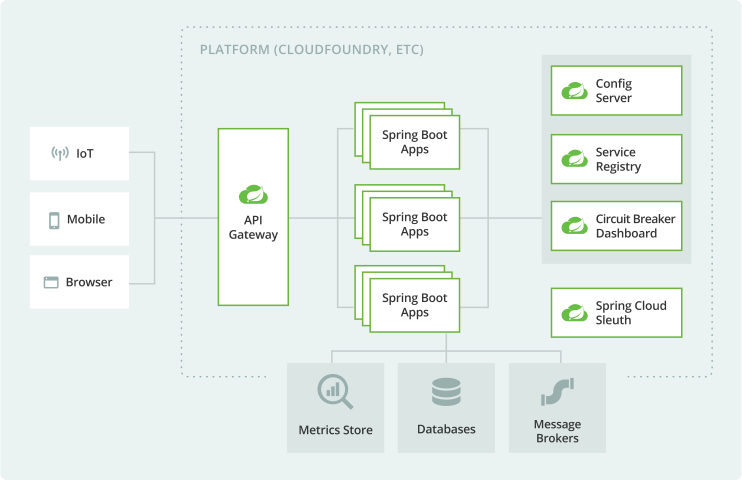
Typical architecture:
Client → API Gateway → Microservices → Database
                    ↓
             Service Discovery
                    ↓
           Config + Messaging
⚙️ Core Components of Spring Cloud
1. Service Discovery (Eureka)
- Services register themselves dynamically
- No hardcoded URLs
2. API Gateway (Spring Cloud Gateway)
- Single entry point
- Handles routing, security, throttling
3. Configuration Server
- Centralized configuration management
- Easy environment switching
4. Load Balancing
- Distributes traffic across instances
5. Circuit Breaker (Resilience4j)
- Prevents cascading failures
6. Distributed Tracing (Sleuth + Zipkin)
- Track requests across services
👉 These patterns are essential for building resilient distributed systems.
🧪 Sample Microservices Setup (Spring Cloud)
1️⃣ Add Dependencies (Maven)
<dependency>
    <groupId>org.springframework.cloud</groupId>
    <artifactId>spring-cloud-starter-netflix-eureka-server</artifactId>
</dependency>

<dependency>
    <groupId>org.springframework.cloud</groupId>
    <artifactId>spring-cloud-starter-openfeign</artifactId>
</dependency>
2️⃣ Eureka Server
@EnableEurekaServer
@SpringBootApplication
public class DiscoveryServerApplication {
    public static void main(String[] args) {
        SpringApplication.run(DiscoveryServerApplication.class, args);
    }
}
3️⃣ Microservice Registration
eureka:
  client:
    service-url:
      defaultZone: http://localhost:8761/eureka/
4️⃣ Inter-Service Communication (Feign)
@FeignClient(name = "order-service")
public interface OrderClient {
    @GetMapping("/orders")
    List<Order> getOrders();
}
🔄 Communication Patterns
Synchronous (REST)
- Feign Client
- WebClient
Asynchronous (Event-driven)
- Kafka / RabbitMQ
- Spring Cloud Stream
Spring Cloud supports both models, enabling scalable event-driven systems.
💡 Advantages of Spring Cloud Microservices
✔ Independent deployment
✔ Better scalability
✔ Fault tolerance
✔ Faster development
✔ Technology flexibility
It simplifies complex distributed system challenges like service communication and configuration.
⚠️ Challenges to Consider
❌ Distributed system complexity
❌ Network latency
❌ Data consistency
❌ Monitoring overhead
👉 Always start with monolith → move to microservices when needed.
🏢 Real-World Example
E-commerce system:
- User Service
- Product Service
- Order Service
- Payment Service
Spring Cloud manages:
- Routing → API Gateway
- Discovery → Eureka
- Communication → Feign/Kafka
- Resilience → Circuit Breaker
🔗 Recommended Articles
- 👉 Java + Spring Security (Authentication & Authorization)
- 👉 Java + Hibernate / JPA → ORM Complete Guide
- 👉 Java + MySQL / PostgreSQL Integration
- 👉 Camunda + Workflow Security
📌 All available at:
👉 https://shikhanirankari.blogspot.com/
French Version: https://shikhanirankari.blogspot.com/2026/04/java-microservices-spring-cloud-guide.html
🏁 Conclusion
Spring Boot + Spring Cloud is the gold standard for Java microservices. It provides:
- Pre-built cloud patterns
- Faster development
- Enterprise-grade scalability
If you're building modern distributed systems, mastering Spring Cloud is essential.
💼 Need Help with Hibernate, JPA, or Backend Systems?
I help teams design scalable applications and resolve production issues.
Services include:
- Hibernate & JPA implementation
- Performance tuning & query optimization
- Database design & architecture
- Enterprise backend systems
🔗 https://shikhanirankari.blogspot.com/p/professional-services.html
📩 Email: ishikhanirankari@gmail.com | info@realtechnologiesindia.com
🌐 https://realtechnologiesindia.com
✔ Available for quick consulting calls
✔ Response within 24 hours
🎥 Learn IT with Shikha on YouTube
Prefer learning through videos? Watch practical tutorials on Kafka, Camunda, Alfresco, Java, Spring Boot, Microservices and Enterprise Architecture.▶ Subscribe to Learn IT with Shikha on YouTube


Comments
Post a Comment